Selling the Cross: Trump, Christian Nationalism and the Company He Keeps
On September 21, 2025, in a stadium in Glendale, Arizona, Erika Kirk stood at the memorial for her murdered husband, Charlie, and said she forgave the man accused of killing him. “The answer to hate is not hate,” she said.
Later, the president took the same stage and praised Kirk: “He did not hate his opponents. He wanted the best for them.” Then he added: “That’s where I disagreed with Charlie. I hate my opponent, and I don’t want the best for them. I’m sorry. I am sorry, Erika.”
He also told the crowd, “We want God back.”
Forgiveness on one side, open contempt on the other, at a memorial staged like a revival. That is the story of Trump and Christianity in one afternoon.
My thesis (this is opinion): Trump has turned Christianity into a brand and Christian voters into a bloc. He sells the Bible, poses with it and lets allies call him God’s chosen instrument, while his conduct contradicts much of what Jesus taught. He has also signaled to, freed and dined with people from the violent edges of American politics. Christian nationalism holds those two things together, and it is dangerous for a diverse country, for the Constitution and for the church itself.
What this post is not: an attack on Christians. Many of the sharpest critics quoted below are Christians, from evangelical editors to Catholic bishops to the pope. My target is the political use of faith.
This builds on earlier posts: The Crazy Things Trump Says, Part 1, History Has Seen This Before and Ten Ways Donald Trump Has Harmed the United States.
First, what is “Christian nationalism”?#
Sociologists Andrew Whitehead and Samuel Perry, in “Taking America Back for God” (Oxford University Press, 2020), describe it as a cultural framework that advocates fusing Christianity with American civic life: the belief that America is, and should officially be, a Christian nation, and that a “real” American is a certain kind of Christian. It is more about identity and power than about orthodox belief.
The nonpartisan research group PRRI measures it with five statements, including “The U.S. government should declare America a Christian nation” and “U.S. laws should be based on Christian values.” In its 2025 survey of more than 22,000 adults, about 11% of Americans were “Adherents” and 21% “Sympathizers.” Roughly two-thirds rejected or were skeptical of the idea.
Why it matters: The First Amendment begins, “Congress shall make no law respecting an establishment of religion, or prohibiting the free exercise thereof.” Article VI says “no religious Test shall ever be required” for public office. The founders protected every faith by keeping government from picking one. Christian nationalism asks it to pick.
Sources
- Whitehead and Perry, “Taking America Back for God” (review, Journal of Church and State)
- PRRI, “A Christian Nation?” (2023, the five-question scale)
- PRRI, 2025 American Values Atlas
- U.S. Constitution, First Amendment (Congress.gov)
- U.S. Constitution, Article VI (Congress.gov)
1. “Christians, get out and vote… you won’t have to vote anymore”#
The record: On July 26, 2024, at Turning Point Action’s “Believers’ Summit” in West Palm Beach, Florida, Trump said: “Christians, get out and vote just this time. You won’t have to do it anymore. Four more years, you know what? It’ll be fixed, it’ll be fine, you won’t have to vote anymore, my beautiful Christians.”
His campaign said he meant “the importance of faith.” Sen. Tom Cotton said he was “obviously making a joke.”
Why it matters (opinion): Joke or not, Christians were addressed not as citizens with consciences but as a turnout operation, activated once to “fix” things for good. Your faith, your vote, his power.
Sources
2. Selling the Bible for $59.99#
The record: In March 2024, facing large legal bills, Trump began promoting the “God Bless the USA Bible,” a King James Bible bundled with founding documents and Lee Greenwood’s lyrics. It sold for $59.99. His August 2024 financial disclosure showed $300,000 from “The Greenwood Bible.” AP later found that about 120,000 of them had been printed in China.
Why it matters (opinion): Jesus drove the money changers out of the temple (Matthew 21:12-13). Trump put his name on the merchandise, packaging scripture and campaign as one product.
Sources
3. The Bible as a prop: Lafayette Square#
The record: On June 1, 2020, during protests after George Floyd’s murder, law enforcement forcibly cleared demonstrators from Lafayette Park. Trump then walked to St. John’s Episcopal Church and held up a Bible for photographers. He didn’t open it, go inside or pray. Asked if it was his Bible, he said, “It’s a Bible.” Washington’s Episcopal bishop, Mariann Budde, whose diocese includes the church, said she was “outraged” that he used the church and the Bible as a backdrop without notice.
In fairness: The Interior Department’s inspector general found in 2021 that Park Police cleared the park to install fencing, not for the photo op, though without adequate warnings.
Why it matters (opinion): Whatever the reason, the image stuck: an unopened Bible held up like a trophy.
Sources
4. “Two Corinthians” and a faith without repentance#
The record: On January 18, 2016, at Liberty University, Trump said, “Two Corinthians, 3:17, that’s the whole ballgame.” Students laughed; Christians say “Second Corinthians.” A bigger tell came on July 18, 2015, at the Family Leadership Summit in Ames, Iowa. Asked whether he had ever asked God for forgiveness, he said: “I am not sure I have. I just go on and try to do a better job from there. I don’t think so… I don’t bring God into that picture.”
Why it matters (opinion): Anyone can misname a book of the Bible. But repentance is the front door of Christianity. A candidate who doesn’t bring God into his mistakes sees faith as something to campaign on, not answer to.
Sources
5. Turning flaws into prophecy: the “Cyrus” and “Jehu” myth#
The record: Some pro-Trump preachers cast him as a modern version of Cyrus, the Persian king in Isaiah whom God used even though he didn’t worship God. “Donald Trump has an anointing upon him. The hand of God is on him,” preacher Lance Wallnau has said. “Cyrus wasn’t even a Jew.” Messianic rabbi Jonathan Cahn said God called Trump “according to the template of Jehu, the warrior king.”
Bible scholars told NPR this is troubling: Jehu took power in a bloody coup and wiped out his rivals’ family line. “The big question with Jehu is just the incredible violence,” said Peter Altmann of the evangelical Fuller Theological Seminary. Wil Gafney of Brite Divinity School noted the obvious omission: “Jesus is not in favor as a model for a national leader.”
Why it matters (opinion): The Cyrus story is a permission slip: cruelty, dishonesty and infidelity don’t matter because God is using him anyway. Once you believe that, no behavior can break the bond, just as Trump bragged in his “Fifth Avenue” line.
Sources
- NPR, “Comparing Trump to biblical kings troubles some people of faith” (Jan. 20, 2025)
- Rebecca Barrett-Fox, “A King Cyrus President” (Humanity & Society, 2018)
6. Faith as state power: the White House Faith Office#
The record: On February 7, 2025, Trump created the White House Faith Office by executive order, led by his longtime spiritual adviser, televangelist Paula White-Cain. A day earlier, at the National Prayer Breakfast, he announced a task force to root out “anti-Christian bias” in the federal government.
In fairness: Presidents of both parties have run faith offices since George W. Bush, and protecting religious freedom is legitimate.
Why it matters (opinion): The difference is framing. A task force for one faith’s grievances, under a leader who says “we want God back,” moves from protecting religion toward sponsoring one. The Establishment Clause holds that line for Christian minorities, other faiths and nonbelievers alike.
Sources
7. “Stand back and stand by”#
The record: At the first presidential debate on September 29, 2020, moderator Chris Wallace asked Trump to condemn white supremacists and militia groups. Trump said, “Proud Boys, stand back and stand by. But I’ll tell you what, somebody’s got to do something about antifa and the left.”
The group cheered. Its Telegram account posted “Standing down and standing by sir,” and one of its social media accounts made “Stand back. Stand by” part of a new logo. Organizer Joe Biggs wrote that Trump “basically said to go f— them up.”
In fairness: The next day, Trump told reporters he didn’t know who the Proud Boys were and that “they have to stand down” and let law enforcement do its work.
Who they are: The Proud Boys are a far-right group with a record of street violence. In 2021 their then-chairman, Enrique Tarrio, was jailed for burning a Black Lives Matter banner stolen from Asbury United Methodist Church, a historic Black church in Washington. In February 2021, Canada added the Proud Boys to its official list of terrorist entities.
Sources
- AP (the debate)
- CNBC (the group’s reaction)
- Reuters (“stand down” the next day)
- AP (Tarrio jailed over church’s banner)
- Public Safety Canada (terrorist listing)
8. From prayer rally to seditious conspiracy#
The record: At the December 2020 “Jericho March,” a Washington prayer rally to keep Trump in office, Oath Keepers founder Stewart Rhodes told the crowd that if Trump didn’t act, “we’re going to have to do it ourselves later, in a much more desperate, much more bloody war.” Christian author Eric Metaxas said in a December 9 interview with Charlie Kirk that “we need to fight to the death, to the last drop of blood.”
On January 6, 2021, rioters carried crosses and “Jesus Saves” signs, and one led a prayer from the Senate dais. Juries later convicted Tarrio, three other Proud Boys leaders and Rhodes of seditious conspiracy. Tarrio got 22 years, the longest January 6 sentence, with a terrorism enhancement.
Why it matters: Seditious conspiracy means conspiring to oppose the government’s authority by force. And the religious language wasn’t decoration. Andrew Whitehead told NPR that when people believe God chose a leader, they won’t “brook any opposition, no matter what.”
Sources
- NPR (Jericho March, Rhodes, Metaxas, Whitehead)
- AP (Christian imagery on Jan. 6)
- Justice Department, Proud Boys verdict (archived; the page has since been removed from justice.gov)
- AP (Tarrio’s 22-year sentence)
9. Pardons, and a dinner at Mar-a-Lago#
The record: On January 20, 2025, his first day back, Trump granted “a full, complete and unconditional pardon” to nearly everyone convicted for January 6, including Tarrio, and commuted 14 others’ sentences, including Rhodes’s.
On November 22, 2022, he hosted Ye (formerly Kanye West), then making antisemitic statements, and Nick Fuentes, a white nationalist and Holocaust denier, for dinner at Mar-a-Lago. Trump said he didn’t know who Fuentes was. Mike Pence called on him to apologize.
Why it matters (opinion): One bad photo is an accident. A pattern is different: no flat condemnation on a debate stage, freedom for leaders convicted of sedition, and dinner with a prominent white nationalist. Groups like these notice who protects them.
Sources
10. Why this mix is dangerous#
The data: Most Christian nationalists aren’t violent; in PRRI’s 2025 survey, two-thirds of Adherents rejected political violence. But 30% agreed that “because things have gotten so far off track, true American patriots may have to resort to violence to save the country.” That compares with 11% of Rejecters (in 2024: 38% versus 7%). And 67% of Adherents believe “immigrants are invading our country and replacing our cultural and ethnic background,” the core idea of the “great replacement” conspiracy theory.
Why it matters (opinion): A movement teaches that America belongs to one group, that the group is under attack and that its leader is chosen by God. Then the leader tells a violent group to “stand by” and pardons its leaders. That is how political disagreement becomes holy war, and holy wars don’t end in compromise. Religious minorities, immigrants and Christians who read the Gospels differently pay first.
Sources
11. The record versus the Sermon on the Mount#
Jesus said “Love your enemies,” “turn the other cheek” and “blessed are the merciful” (Matthew 5). Hold the record up to that:
- “I hate my opponent.” At a memorial, after praising forgiveness (September 21, 2025).
- “Good, I’m glad he’s dead.” His Truth Social post on March 21, 2026, after former FBI Director Robert Mueller died.
- “Quiet. Quiet, piggy.” To Bloomberg’s Catherine Lucey on Air Force One, November 14, 2025, when she asked about the Epstein files.
- “Grab ’em by the p***y. You can do anything.” On the 2005 “Access Hollywood” tape released in October 2016. He apologized at the time and called it “locker room talk.”
- 34 felonies. On May 30, 2024, a Manhattan jury convicted him of falsifying business records to hide hush money paid to an adult film star. His sentence: an unconditional discharge.
- Sexual abuse and defamation. A federal jury found him liable for sexually abusing E. Jean Carroll and defaming her ($5 million), and a second jury awarded her $83.3 million for further defamation. An appeals court upheld both awards, and in June 2026 the Supreme Court declined to hear his appeal of the $5 million verdict. Trump denies her account.
Why it matters (opinion): Christians don’t demand sinless leaders. But this isn’t a man who stumbles and repents; he boasts.
Sources
- Rev transcript, Kirk memorial
- American Presidency Project (Mueller post)
- American Presidency Project (Air Force One transcript)
- NBC News (the “Access Hollywood” tape)
- AP (guilty on 34 counts)
- AP ($5 million verdict upheld)
- AP ($83.3 million upheld)
- Reuters (Supreme Court declines the $5 million appeal)
12. When the church says “have mercy,” he hits back#
The record: At the inaugural prayer service on January 21, 2025, Bishop Budde asked Trump, “In the name of our God,” to “have mercy upon the people in our country who are scared now,” including LGBTQ+ children and immigrants. Trump called her a “Radical Left hard line Trump hater” who was “nasty in tone.”
In November 2025, the U.S. Catholic bishops voted 216 to 5 for a statement opposing “the indiscriminate mass deportation of people.” In April 2026, after Pope Leo XIV criticized the war with Iran, Trump called the pope “WEAK on Crime, and terrible for Foreign Policy” and refused to apologize. Leo’s answer: “The message of the Gospel is very clear: ‘Blessed are the peacemakers.’”
Why it matters (opinion): Trump embraces Christianity when it cheers and attacks it when it asks for mercy. When a bishop, a bishops’ conference and a pope say the same thing and get insults back, it isn’t the church that left the Gospel.
Sources
- PBS/AP (Budde’s sermon and Trump’s response)
- USCCB special message on immigration
- CBS News (Trump on Pope Leo, and Leo’s reply)
- AP (no apology)
13. The unyielding support, and why it isn’t really about faith#
The data: In Pew Research Center’s study of validated 2024 voters, 81% of white evangelical Protestants voted for Trump, down slightly from 83% in 2020. But the support doesn’t rest on believing he’s devout. In a 2020 Pew survey, only 12% of white evangelicals called him “very religious,” and just 15% said “morally upstanding” described him very well. What they did agree on: 81% said he “fights for what I believe in.”
Nor is the support universal. In April 2024, Pew found 77% of Black Protestant voters preferred his opponent. In 2019, Christianity Today, founded by Billy Graham, said Trump “should be removed from office,” calling his conduct “profoundly immoral.” In 2021, more than 100 evangelical leaders signed a letter calling “radicalized Christian nationalism” a “heresy.”
Why it matters (opinion): For many supporters, Trump isn’t a pastor but a fighter, and faith language makes the fight feel holy. That’s a trade: character for power. Christianity Today put it plainly: “None of the president’s positives can balance the moral and political danger we face under a leader of such grossly immoral character.”
Sources
- Pew Research Center, 2024 validated voters
- Pew Research Center, 2020 (views of Trump’s traits)
- Pew Research Center, April 2024 (votes by religion)
- Christianity Today editorial (Dec. 19, 2019)
- NPR (evangelical leaders’ letter)
What the internet thinks: the memes#
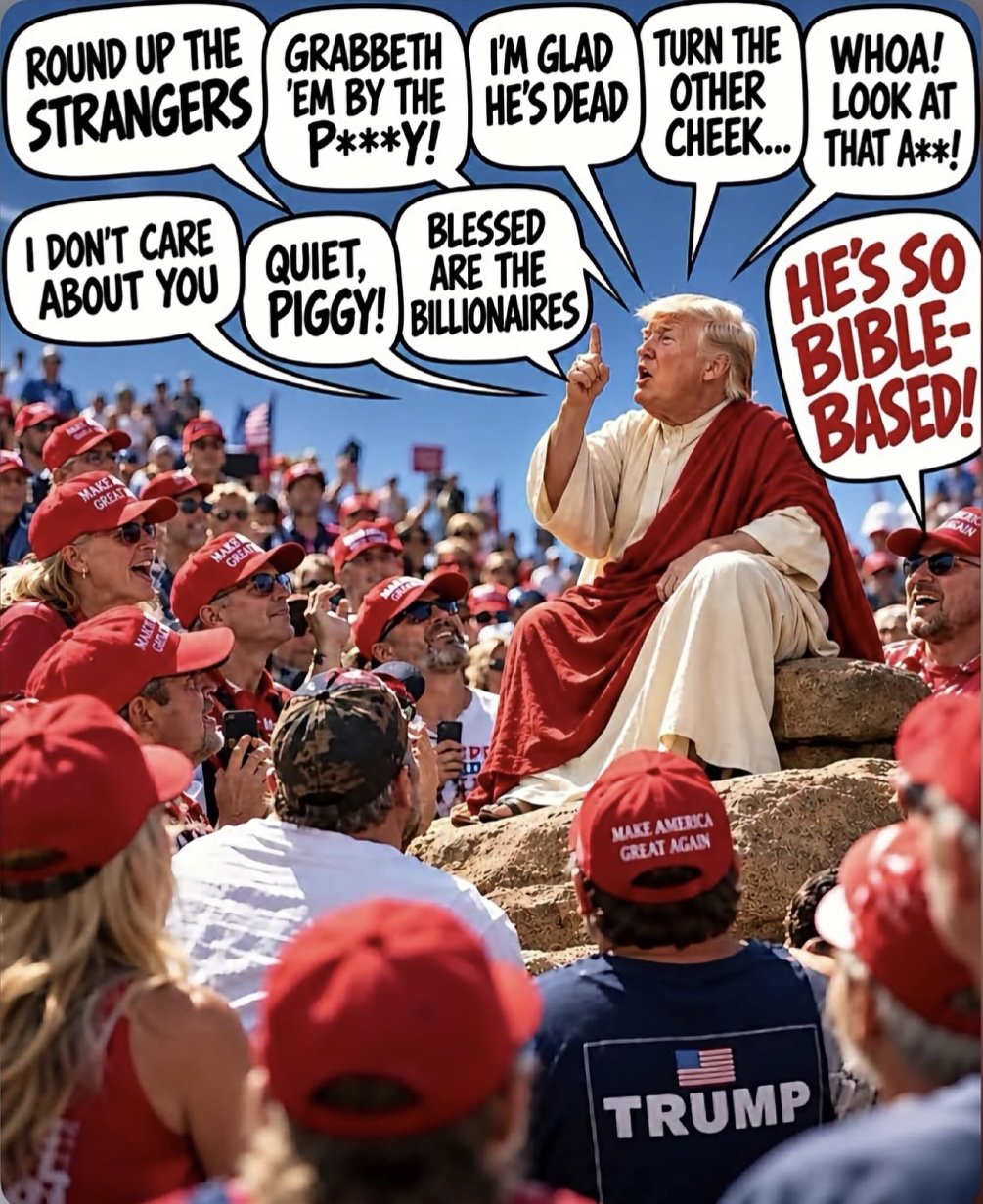
Satire, not a real photo. An apparently AI-generated meme circulating online; creator unknown. The fact-check below shows which lines echo real Trump remarks.
What the meme is riffing on#
- “Round up the strangers”: Parody of a real 2024 pledge, “the largest deportation operation in the history of our country,” set against Matthew 25:35: “I was a stranger and you invited me in.”
- “Grabbeth ’em by the P***y!”: Real, in King James spelling (2005 “Access Hollywood” tape).
- “I’m glad he’s dead”: Real (March 21, 2026 post about Robert Mueller).
- “Turn the other cheek…”: Jesus’s words (Matthew 5:39), not Trump’s, set against “I hate my opponent.”
- “Whoa! Look at that A**!”: Paraphrase. At an October 25, 2026 rally in Port Huron, Michigan, he said “I looked at one hell of a beautiful a** before,” about Nicki Minaj, who was in the audience (Snopes confirmed).
- “I don’t care about you”: Real but out of context. At a hot Las Vegas rally on June 9, 2024, he said “I don’t care about you, I just want your vote,” joking about the heat (Snopes).
- “Quiet, piggy!”: Real (November 14, 2025).
- “Blessed are the billionaires”: Pure parody of “Blessed are you who are poor” (Luke 6:20).
- “He’s so Bible-based!”: Pure parody; not anyone’s quote.
Score: four lines are real Trump quotes (one out of context), one paraphrases a real remark, one parodies a real pledge, and three are invention or scripture. The parody barely has to make anything up.
Three more moments the internet couldn’t let go#
- “Two Corinthians” (2016). The Liberty University slip became a punchline about a candidate who doesn’t know the book he’s selling.
- Trump as pope (May 2025). Days after Pope Francis’s funeral, Trump posted an AI image of himself in papal robes. The New York State Catholic Conference replied: “There is nothing clever or funny about this image, Mr. President… Do not mock us.”
- Trump as Jesus (April 2026). Mid-feud with Pope Leo, Trump posted an AI image of himself in a white robe, healing a sick man with light flowing from his fingers. Conservative Christian commentator Megan Basham called it “OUTRAGEOUS blasphemy.” He deleted it and said he thought it showed him “as a doctor.” Real life had made the meme above.
Sources
- NPR (deportation pledge)
- Snopes (Minaj remark)
- Snopes (“I don’t care about you,” with context)
- NPR (pope image reactions)
- Reuters (Jesus image)
- CNBC (Basham quote and “as a doctor”)
The bottom line#
This section is my analysis and opinion.
Strip away the stagecraft and the pattern is simple. Trump uses Christianity the way he uses everything else: as a brand, a loyalty test and a source of money and votes. Meanwhile he says he doesn’t ask God for forgiveness, celebrates a dead man, calls a reporter “piggy,” tells a grieving widow he hates his opponent and insults a pope who quotes the Beatitudes back to him.
The extremist links make it dangerous, not just hypocritical. Telling the Proud Boys to “stand by,” freeing their convicted leaders and dining with a Holocaust denier aren’t faith. They are signals. Add a movement that believes America belongs to one kind of Christian, and you get what PRRI’s data shows: more openness to political violence, less room for neighbors who believe differently.
None of this is an argument against Christianity. The loudest warnings came from inside the church: Christianity Today, a bishop in her own cathedral, 216 Catholic bishops, more than 100 evangelical leaders and the pope. Their point: faith judges power, not the other way around.
Seen from abroad, this story is familiar. Leaders in many faiths and nations have wrapped themselves in religion to divide their countries, and it rarely ends well for the believers they claim to protect. America’s founders kept church and state apart to protect both.
Jesus warned about this, too: “Not everyone who says to me, ‘Lord, Lord,’ will enter the kingdom of heaven” (Matthew 7:21). Words are cheap, and Bibles cost $59.99. Judge by the fruit.
Scripture: NIV and KJV via Bible Gateway.